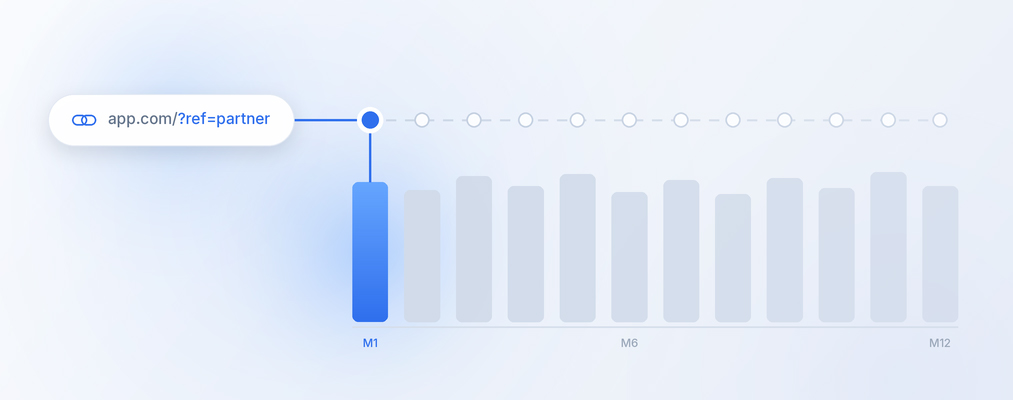
In January an affiliate sends a customer to your site. The tracking records one sale: $49. By the following January that customer has upgraded twice and paid you $1,400 and your affiliate software still shows $49. The tool did its job. It was built for ecommerce, where $49 is the entire transaction.
Ecommerce affiliate tracking fires on the order confirmation page: a shopper clicks a link and buys, the tool records the sale and works out the commission. For a store selling one-off products this design is correct, and the affiliate software category grew up around it. Subscription companies inherited those tools and the design stopped matching the business. A SaaS customer produces a first payment, then renewals every month or year, plan changes in both directions and sometimes a refund. Tracking that ends at a confirmation page records the first payment and goes quiet, while the actual revenue keeps arriving.
I run marketing at FirstPromoter, an affiliate tracking platform for SaaS companies, so I have an obvious interest in this argument. I also get to watch what happens when a subscription business tries to run its program on tooling built for retail, because those are the teams that end up talking to us.
The billing platform knows things a confirmation page never will
SaaS tracking listens somewhere else entirely: to billing events inside the subscription billing platform, the moment a charge succeeds in Stripe or a plan changes in Paddle. The tracking sits on the system that actually moves the money.
That placement is the root of every practical difference between the two categories. A confirmation page knows one thing: an order just happened. A billing platform knows what plan the customer is on, every payment they’ve made so far and what changed along the way, and commission logic that runs on billing events can react to all of it. Logic tied to a confirmation page never hears about anything after the first purchase.
One customer, many billing events
A subscription customer is one relationship expressed through many billing events. The payment in month 14 belongs to the same relationship as the payment in month 1 and the affiliate who started that relationship is still the reason it exists. Tracking built for SaaS honors that continuity, which is what makes the awkward cases solvable. An upgrade raises the recurring commission automatically, because the system reads it as a change inside an existing relationship. Downgrades get the same treatment in reverse, and when a customer refunds or churns, the commission is corrected or ends with them.
Ecommerce tools record each sale as a separate entity. Order #4417 has no memory of order #3201 and it doesn’t need one, because in retail they really are unrelated purchases.
Force those same events through a tool that sees only separate transactions and each one becomes manual work. Somebody exports the month’s payments, matches them against affiliate records, adjusts commissions in a spreadsheet and hopes nothing slipped through. We’ve onboarded teams whose affiliate manager lost the first two days of every month to exactly this routine. Their old tracking tool had been working as designed the whole time, but the problem was that this design assumed retail.
The money involved is bigger than it looks. ChartMogul’s SaaS Growth Report puts expansion revenue at 36% of new ARR for SaaS companies in the $15 to 30 million ARR range. That is revenue created by upgrades, after the first payment, in the part of the customer lifecycle that confirmation-page tracking cannot see. An affiliate program that only credits first payments excludes a third of the growth its partners help create.
The click and the sale can be two years apart
Companies buy software on a longer clock than shoppers buy socks. In ecommerce, attribution runs from click to sale and the cookie window sits somewhere between 24 hours and 30 days, which fits that pace. The person who clicks an affiliate’s link today might start a free trial, use it for a while, go quiet, come back next quarter when the budget opens and convert to a paid plan long after any retail cookie would have expired.
SaaS attribution handles this by splitting the journey in two: the click is tied to the registration and the registration is tied to every payment that follows. Once someone signs up through an affiliate’s link, the paid conversion can happen two years later and still credit the right partner. That only holds if the company’s data retention policies actually keep the history, so check them before you promise affiliates lifetime attribution.
The registration itself is a conversion worth tracking and here the two worlds barely overlap. Ecommerce tools almost never track signups, because a retail store has nothing to sign up for. In SaaS the trial start is the first meaningful conversion, the one your funnel metrics hang on and the one some programs pay partners for directly. Cost-per-lead campaigns, a normal motion in SaaS partner programs, cannot be expressed in ecommerce affiliate software at all. There is no lead in its vocabulary.
Commission logic has a time dimension
A retail commission needs one input: the order value. A subscription commission also depends on where the relationship stands, starting with which payment in the sequence this one is.
Real programs use that time dimension constantly. A common structure pays 30% on the first payment and 10% on every payment after, front-loading the reward while keeping the long tail attractive. Another does the reverse to filter for quality: 10% for the first 3 months, then 40% from month 4 onward, so partners only earn serious money on customers who actually stick. Which of these fits your program is a strategy debate. Implementing them at all is a tooling constraint: a system that sees each sale as an isolated event has no concept of “the fourth payment”, so commission rules built on payment sequence are unbuildable in ecommerce-based software.
At this point the platform choice starts to shape program design itself. Teams on subscription-native tracking set these rules in the dashboard and move on. At FirstPromoter that’s [FP link: commission structures] configured per campaign. Teams on retail tooling either abandon the structure they wanted or recreate it by hand every payout cycle and hand-recreated commission logic is where payout disputes start.
Nobody budgeted for the integration project
Ecommerce affiliate tools read order data from the store’s backend, and someone has to build and maintain that connection. Nobody prices this in when the contract is signed. For a SaaS company it turns “set up affiliate tracking” into a development project: engineers wiring order data into a tool whose data model doesn’t match the business, then maintaining that integration through every billing change that follows.
Integrating at the billing platform level removes that layer. The billing system already knows every subscription, payment, upgrade and refund, so tracking that connects there inherits the full picture without custom plumbing. In practice this is the difference between an afternoon of setup owned by the marketing team and a sprint owned by engineers who have better things to do. For founders weighing the switch, it’s also the hidden cost that never appears on the pricing page of a retail-first tool.
Match the tracking to the revenue model
Ecommerce affiliate software remains good at its own job. For a store selling one-off products, connecting a click to an order covers the entire task. A subscription business needs its tracking to hold a longer thought: which partner brought in this customer relationship and what that relationship turns out to be worth over time. No configuration menu closes that gap, because the gap sits in where the tracking listens and what it remembers.
So before comparing feature lists, compare assumptions. Ask where a platform’s tracking fires and what it knows about payment number 14. If “10% until month 3, 40% after” turns out to be a spreadsheet rather than a setting, you have your answer.
We built FirstPromoter for exactly this: tracking tied to billing events and commission logic that understands time. If you run a subscription business and your affiliate payouts still depend on a monthly spreadsheet, FirstPromoter is a good place to start.
Related Categories