Average Ratings 0 Ratings
Average Ratings 0 Ratings
Similar Products
-
LTXMost AI video tools hand you a black box: closed weights, a subscription, and no way to see what is happening under the hood. LTX takes the opposite approach. Built by Lightricks, LTX is an open foundation model that generates and simulates across video, audio, and the physical world, and it puts the weights, the code, and the control in your hands. At the center of the model is LTX-2.5, a 22B-parameter dual-stream diffusion transformer that produces native 4K video at up to 50 frames per second, with audio and video generated together in a single pass rather than stitched together afterward. Artificial Analysis, an independent benchmarking group, currently ranks LTX among the top three AI video models in the world. You choose how you want to use it. Download the open weights and run LTX-2.5 on your own hardware. License the model for on-premise deployment backed by enterprise support. Or build directly on LTX Studio, the production suite that turns the model into a full creative workflow. Companies like ElevenLabs, Asteria Film Co., Magnopus, and NVIDIA already rely on LTX for their own work. LTX is not built for one-off social clips. It is infrastructure for teams that generate motion, audio, and physical environments as part of their own products and pipelines.
-
Azore CFDAzore is software for computational fluid dynamics. It analyzes fluid flow and heat transfers. CFD allows engineers and scientists to analyze a wide range of fluid mechanics problems, thermal and chemical problems numerically using a computer. Azore can simulate a wide range of fluid dynamics situations, including air, liquids, gases, and particulate-laden flow. Azore is commonly used to model the flow of liquids through a piping or evaluate water velocity profiles around submerged items. Azore can also analyze the flow of gases or air, such as simulating ambient air velocity profiles as they pass around buildings, or investigating the flow, heat transfer, and mechanical equipment inside a room. Azore CFD is able to simulate virtually any incompressible fluid flow model. This includes problems involving conjugate heat transfer, species transport, and steady-state or transient fluid flows.
-
RaimaDBRaimaDB, an embedded time series database that can be used for Edge and IoT devices, can run in-memory. It is a lightweight, secure, and extremely powerful RDBMS. It has been field tested by more than 20 000 developers around the world and has been deployed in excess of 25 000 000 times. RaimaDB is a high-performance, cross-platform embedded database optimized for mission-critical applications in industries such as IoT and edge computing. Its lightweight design makes it ideal for resource-constrained environments, supporting both in-memory and persistent storage options. RaimaDB offers flexible data modeling, including traditional relational models and direct relationships through network model sets. With ACID-compliant transactions and advanced indexing methods like B+Tree, Hash Table, R-Tree, and AVL-Tree, it ensures data reliability and efficiency. Built for real-time processing, it incorporates multi-version concurrency control (MVCC) and snapshot isolation, making it a robust solution for applications demanding speed and reliability.
-
LM-Kit.NETLM-Kit.NET is an enterprise-grade toolkit designed for seamlessly integrating generative AI into your .NET applications, fully supporting Windows, Linux, and macOS. Empower your C# and VB.NET projects with a flexible platform that simplifies the creation and orchestration of dynamic AI agents. Leverage efficient Small Language Models for on‑device inference, reducing computational load, minimizing latency, and enhancing security by processing data locally. Experience the power of Retrieval‑Augmented Generation (RAG) to boost accuracy and relevance, while advanced AI agents simplify complex workflows and accelerate development. Native SDKs ensure smooth integration and high performance across diverse platforms. With robust support for custom AI agent development and multi‑agent orchestration, LM‑Kit.NET streamlines prototyping, deployment, and scalability—enabling you to build smarter, faster, and more secure solutions trusted by professionals worldwide.
-
DragonflyDragonfly serves as a seamless substitute for Redis, offering enhanced performance while reducing costs. It is specifically engineered to harness the capabilities of contemporary cloud infrastructure, catering to the data requirements of today’s applications, thereby liberating developers from the constraints posed by conventional in-memory data solutions. Legacy software cannot fully exploit the advantages of modern cloud technology. With its optimization for cloud environments, Dragonfly achieves an impressive 25 times more throughput and reduces snapshotting latency by 12 times compared to older in-memory data solutions like Redis, making it easier to provide the immediate responses that users demand. The traditional single-threaded architecture of Redis leads to high expenses when scaling workloads. In contrast, Dragonfly is significantly more efficient in both computation and memory usage, potentially reducing infrastructure expenses by up to 80%. Initially, Dragonfly scales vertically, only transitioning to clustering when absolutely necessary at a very high scale, which simplifies the operational framework and enhances system reliability. Consequently, developers can focus more on innovation rather than infrastructure management.
-
Planview AdaptiveWorkPlanview AdaptiveWork, previously known as Clarizen, empowers PMOs and professional services teams of various sizes to achieve instant visibility across their operations, streamline workflows, proactively address potential risks, and enhance overall business outcomes. By aligning with the company’s strategic objectives, organizations can maximize workforce effectiveness, ensuring that teams concentrate on delivering the most critical tasks timely. It facilitates the tracking, management, and prioritization of work requests, guaranteeing that each request automatically encompasses all necessary information for execution. With bi-directional integration with your CRM and custom triggers in place, opportunity details can be effortlessly captured to aid in planning client projects. The platform automates and governs the various phases of the request lifecycle, including submission, scoring, prioritization, routing, and approval, thereby streamlining the pathway for converting requests into actionable projects, tasks, or work items. This comprehensive approach not only boosts efficiency but also fosters a culture of accountability and transparency within the organization.
-
The Asset Guardian EAM (TAG)The Asset Guardian (TAG) Mobi: Tackle Downtime with TAG Mobi TAG Mobi is a fully embedded preventive maintenance and asset management (EAM) solution within Microsoft Dynamics 365 Business Central. Designed for modern manufacturing and infrastructure operations, TAG Mobi helps reduce risk, minimize downtime, and streamline maintenance workflows—all from within your existing Business Central environment. From proactive asset health monitoring and predictive maintenance to real-time mobility and AI-powered adoption tools, TAG Mobi equips maintenance teams with everything they need to boost performance and take control of asset operations. Key Features: • Fully embedded in Microsoft Dynamics 365 Business Central • Real-time mobile access for on-the-go asset tracking • Predictive maintenance to reduce unplanned downtime • AI-assisted onboarding for faster adoption • Advanced APM tools to monitor asset health and anticipate failures No silos. No extra software. Just a seamless, native experience that empowers maintenance teams and provides managers with the insights they need—right inside Business Central.
-
YodeckNext-generation technology for digital signage professionals Yodeck, a cloud-based digital signage platform, is unbeatable. It powers your screen with dynamic content that instantly engages your target audience. Yodeck makes it easy to create, schedule, and design content from the web. To get your message across to those who matter most to you, use attention-grabbing media such as videos, images and PDF files, Office documents, data dashboards, and social media. It provides enterprise-grade security and control. Yodeck's drag-and-drop editing feature allows users to be creative in organizing content into interesting layouts. Yodeck is proud to offer a unique digital signage solution for businesses of all sizes. This includes local diners as well as global leaders like Delta Airlines, Autodesk and Adobe.
-
FinOpslyMost enterprises can report what AI cost them. Far fewer can say which team owns it, whether it was approved, or what it returned. FinOpsly closes that gap. The platform governs AI spend on the same cost model that carries the cloud, data platform and SaaS an AI workload consumes, so a business unit sees the full cost of an AI initiative instead of four disconnected bills. Capabilities include: Cost estimation before deployment. Model an architecture and get a priced workload across model APIs, GPU capacity, warehouse consumption and storage, with the assumptions on screen. Weigh model choices against consumption you have actually measured. Attribution that holds up in a chargeback cycle. Spend resolves to owners, teams, applications, business units and customers through hierarchies nine or more levels deep. Tagging is standardized across providers, keys and resources are labeled in bulk from plain-language rules, and whatever remains unattributed is published as a number, not absorbed. Guardrails that act. Set budgets by project, team or API key. Catch anomalies with root cause and route them to whoever owns the resource. Surface waste that provider tooling misses, using FinOpsly's own detection models. Plan commitments across AWS, Azure and Google Cloud. Park idle compute on approved schedules, reversibly. Financial results you can defend. Automated chargeback in a single cycle. Savings measured as what reached run-rate against a no-action baseline. Unit economics down to cost per call, per active user and per customer served. For technology and finance leaders accountable for what AI spend returns.
-
Google Compute EngineCompute Engine (IaaS), a platform from Google that allows organizations to create and manage cloud-based virtual machines, is an infrastructure as a services (IaaS). Computing infrastructure in predefined sizes or custom machine shapes to accelerate cloud transformation. General purpose machines (E2, N1,N2,N2D) offer a good compromise between price and performance. Compute optimized machines (C2) offer high-end performance vCPUs for compute-intensive workloads. Memory optimized (M2) systems offer the highest amount of memory and are ideal for in-memory database applications. Accelerator optimized machines (A2) are based on A100 GPUs, and are designed for high-demanding applications. Integrate Compute services with other Google Cloud Services, such as AI/ML or data analytics. Reservations can help you ensure that your applications will have the capacity needed as they scale. You can save money by running Compute using the sustained-use discount, and you can even save more when you use the committed-use discount.
Description
Qwen3.8-Flash-Next represents an open-weight multimodal Mixture-of-Experts architecture and serves as an initial glimpse into the design intended for Qwen4. This model strategically enhances attention mechanisms, residual pathways, embeddings, and optimization techniques to boost its capabilities, improve computational efficiency, expand model capacity, and ensure training stability. Its innovative hybrid architecture merges Gated DeltaNet, which adeptly compresses past information, with Qwen Sparse Attention, enabling the selection of significant context at a micro-block level to lessen both attention and indexing costs associated with lengthy sequences. The Gated Residual feature broadens the residual pathway into four streams, dynamically managing the flow of information across different layers. Additionally, the N-gram Embedding integrates large-scale local-pattern memory with minimal added computation per token, and it can be transferred to host memory for further efficiency. The model is structured around a 125B-parameter main network supplemented by 51B parameters dedicated to N-gram embeddings, activating only 6B parameters for each token processed. This sophisticated framework highlights the ongoing advancements in machine learning architectures, setting a promising stage for future developments.
Description
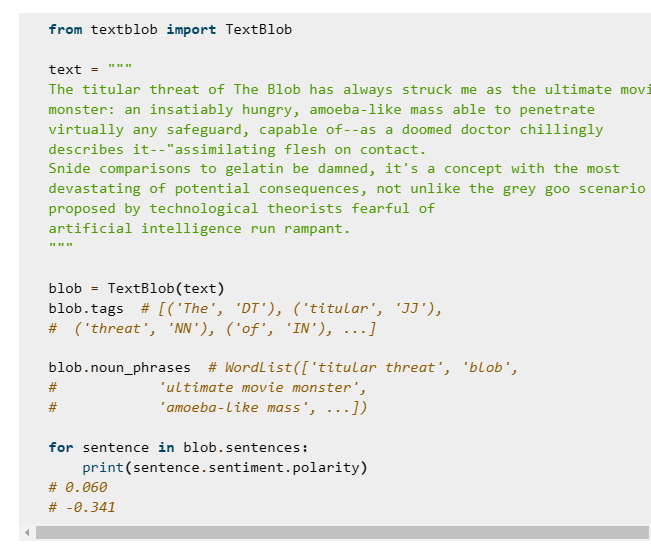
TextBlob is a Python library designed for handling textual data, providing an intuitive API to carry out various natural language processing functions such as part-of-speech tagging, sentiment analysis, noun phrase extraction, and classification tasks. Built on the foundations of NLTK and Pattern, it integrates seamlessly with both libraries. Notable features encompass tokenization (the division of text into words and sentences), frequency analysis of words and phrases, parsing capabilities, n-grams, and word inflection (both pluralization and singularization), alongside lemmatization, spelling correction, and integration with WordNet. TextBlob is compatible with Python versions 2.7 and higher, as well as 3.5 and above. The library is actively maintained on GitHub and is released under the MIT License. For users seeking guidance, thorough documentation is readily accessible, including a quick start guide and a variety of tutorials to facilitate the implementation of different NLP tasks. This rich resource equips developers with the tools necessary to enhance their text processing capabilities.
API Access
Has API
Yes
API Access
Has API
Yes


Integrations
Python
Yes
Alibaba Cloud
Yes
Alibaba Cloud Model Studio
Yes
Cherry Studio
Yes
Cline
Yes
ClinePass
Yes
Hermes Agent
Yes
Hugging Face
Yes
Model Context Protocol (MCP)
Yes
ModelScope
Yes
Integrations
Python
Yes
Alibaba Cloud
No
Alibaba Cloud Model Studio
No
Cherry Studio
No
Cline
No
ClinePass
No
Hermes Agent
No
Hugging Face
No
Model Context Protocol (MCP)
No
ModelScope
No
Pricing Details
$2 per 1M (input)
Free Trial
No
Free Version
No
Pricing Details
No price information available.
Free Trial
No
Free Version
No
Deployment
Web-Based
Yes
On-Premises
No
iPhone App
No
iPad App
No
Android App
No
Windows
No
Mac
No
Linux
No
Chromebook
No
Deployment
Web-Based
No
On-Premises
No
iPhone App
No
iPad App
No
Android App
No
Windows
Yes
Mac
Yes
Linux
Yes
Chromebook
No
Customer Support
Business Hours
No
Live Rep (24/7)
No
Online Support
Yes
Customer Support
Business Hours
No
Live Rep (24/7)
No
Online Support
Yes
Types of Training
Training Docs
Yes
Webinars
No
Live Training (Online)
No
In Person
No
Types of Training
Training Docs
Yes
Webinars
No
Live Training (Online)
No
In Person
No
Vendor Details
Company Name
Alibaba
Founded
1999
Country
China
Website
qwen.ai/blog
Vendor Details
Company Name
TextBlob
Country
United States
Website
textblob.readthedocs.io/en/dev/
Product Features
Product Features
Natural Language Processing
Co-Reference Resolution
No
In-Database Text Analytics
No
Named Entity Recognition
No
Natural Language Generation (NLG)
No
Open Source Integrations
No
Parsing
No
Part-of-Speech Tagging
No
Sentence Segmentation
No
Stemming/Lemmatization
No
Tokenization
No
