Average Ratings 0 Ratings
Average Ratings 0 Ratings
Similar Products
-
Gemini Enterprise Agent PlatformGemini Enterprise Agent Platform is Google Cloud’s next-generation system for designing and managing advanced AI agents across the enterprise. Built as the successor to Vertex AI, it unifies model selection, development, and deployment into a single scalable environment. The platform supports a vast ecosystem of over 200 AI models, including Google’s latest Gemini innovations and popular third-party models. It offers flexible development tools like Agent Studio for visual workflows and the Agent Development Kit for deeper customization. Businesses can deploy agents that operate continuously, maintain long-term memory, and handle multi-step processes with high efficiency. Security and governance are central, with features such as agent identity verification, centralized registries, and controlled access through gateways. The platform also enables seamless integration with enterprise systems, allowing agents to interact with data, applications, and workflows securely. Advanced monitoring tools provide real-time insights into agent behavior and performance. Optimization features help refine agent logic and improve accuracy over time. By combining automation, intelligence, and governance, the platform helps organizations transition to autonomous, AI-driven operations. It ultimately supports faster innovation while maintaining enterprise-grade reliability and control.
-
LM-Kit.NETLM-Kit.NET is an enterprise-grade toolkit designed for seamlessly integrating generative AI into your .NET applications, fully supporting Windows, Linux, and macOS. Empower your C# and VB.NET projects with a flexible platform that simplifies the creation and orchestration of dynamic AI agents. Leverage efficient Small Language Models for on‑device inference, reducing computational load, minimizing latency, and enhancing security by processing data locally. Experience the power of Retrieval‑Augmented Generation (RAG) to boost accuracy and relevance, while advanced AI agents simplify complex workflows and accelerate development. Native SDKs ensure smooth integration and high performance across diverse platforms. With robust support for custom AI agent development and multi‑agent orchestration, LM‑Kit.NET streamlines prototyping, deployment, and scalability—enabling you to build smarter, faster, and more secure solutions trusted by professionals worldwide.
-
RunpodRunpod provides a cloud infrastructure that enables seamless deployment and scaling of AI workloads with GPU-powered pods. By offering access to a wide array of NVIDIA GPUs, such as the A100 and H100, Runpod supports training and deploying machine learning models with minimal latency and high performance. The platform emphasizes ease of use, allowing users to spin up pods in seconds and scale them dynamically to meet demand. With features like autoscaling, real-time analytics, and serverless scaling, Runpod is an ideal solution for startups, academic institutions, and enterprises seeking a flexible, powerful, and affordable platform for AI development and inference.
-
Bright DataBright Data holds the title of the leading platform for web data, proxies, and data scraping solutions globally. Various entities, including Fortune 500 companies, educational institutions, and small enterprises, depend on Bright Data's offerings to gather essential public web data efficiently, reliably, and flexibly, enabling them to conduct research, monitor trends, analyze information, and make well-informed decisions. With a customer base exceeding 20,000 and spanning nearly all sectors, Bright Data's services cater to a diverse range of needs. Its offerings include user-friendly, no-code data solutions for business owners, as well as a sophisticated proxy and scraping framework tailored for developers and IT specialists. What sets Bright Data apart is its ability to deliver a cost-effective method for rapid and stable public web data collection at scale, seamlessly converting unstructured data into structured formats, and providing an exceptional customer experience—all while ensuring full transparency and compliance with regulations. This commitment to excellence has made Bright Data an essential tool for organizations seeking to leverage web data for strategic advantages.
-
CloudflareCloudflare is the foundation of your infrastructure, applications, teams, and software. Cloudflare protects and ensures the reliability and security of your external-facing resources like websites, APIs, applications, and other web services. It protects your internal resources, such as behind-the firewall applications, teams, devices, and devices. It is also your platform to develop globally scalable applications. Your website, APIs, applications, and other channels are key to doing business with customers and suppliers. It is essential that these resources are reliable, secure, and performant as the world shifts online. Cloudflare for Infrastructure provides a complete solution that enables this for everything connected to the Internet. Your internal teams can rely on behind-the-firewall apps and devices to support their work. Remote work is increasing rapidly and is putting a strain on many organizations' VPNs and other hardware solutions.
-
Google AI StudioGoogle AI Studio is an all-in-one environment designed for building AI-first applications with Google’s latest models. It supports Gemini, Imagen, Veo, and Gemma, allowing developers to experiment across multiple modalities in one place. The platform emphasizes vibe coding, enabling users to describe what they want and let AI handle the technical heavy lifting. Developers can generate complete, production-ready apps using natural language instructions. One-click deployment makes it easy to move from prototype to live application. Google AI Studio includes a centralized dashboard for API keys, billing, and usage tracking. Detailed logs and rate-limit insights help teams operate efficiently. SDK support for Python, Node.js, and REST APIs ensures flexibility. Quickstart guides reduce onboarding time to minutes. Overall, Google AI Studio blends experimentation, vibe coding, and scalable production into a single workflow.
-
kama.aikama.ai is a Responsible AI Agent platform that gives you an accurate, accountable, and safe AI for your organization. It is used for training, quick source of truth for compliance issues, internal support, customer service, and for specialized communities needs. Unlike generic GenAI tools that create answers probabilistically, kama.ai combines deterministic Knowledge Graph AI with governed Generative AI and Trusted Collections. Trusted Collections is a RAG technology that minimizes generative side hallucinations, while providing a core source for accurate, brand-safe, and a correct information source for AI answers. It lets organizations control what their AI Agents know, where answers come from, and how information is delivered to employees, customers, learners, members, or community users. kama.ai’s platform is designed for situations where answers must be accurate, traceable, brand-safe, and aligned with approved source material. Human experts and Knowledge Managers can curate content, review AI-generated drafts, manage knowledge domains, and improve responses over time. This supports a governed-in-advance approach to AI, rather than relying on after-the-fact correction. kama.ai is especially well suited for knowledge-heavy organizations, training programs, compliance environments, Indigenous and community-focused initiatives, HR support, education, research, and other use cases where trusted information matters. This platform focused on Responsible AI use and delivery, results in safer AI adoption, better knowledge access, reduced repetitive workload, and more consistent support for the people who rely on your organization’s expertise. Think kama.ai for trusted AI, governed knowledge, and answers your organization is willing to stand behind.
-
ConcordConcord Horizon is an AI native contract platform built from a complete rewrite of Concord’s technology, applying ten years of experience to a modern architecture for faster and more accurate contract work. The redesigned interface offers light and dark mode, collapsible navigation, full screen focus, custom columns, advanced filtering, and consistent tables across modules. AI Copilot supports natural language questions, contract summaries, key point extraction, and fast portfolio insights, while AI Search adds lexical and semantic search with improved performance and multi actions on results. MCP brings contract intelligence into AI tools like ChatGPT and Claude for summaries, tables, or automated monitoring. Concord applies a strict zero data retention policy with AI partners and never uses customer data to train AI models .
-
AnalyticsCreatorAnalyticsCreator is a metadata-driven design application for data warehouse automation and data product engineering across the Microsoft data stack. Its Governed Control Model connects business meaning, data structures, transformation rules, dependencies, lineage and technical implementation in one controlled project model. Data teams design the required architecture in AnalyticsCreator, then generate native Microsoft assets from that design. Generated outputs can include SQL Server objects, SSIS packages, Azure Data Factory pipelines, supported Microsoft Fabric components, deployment artefacts and Power BI semantic models. AnalyticsCreator supports dimensional, 3NF and hybrid modelling approaches together with ingestion, transformations, delta loading, historisation, Slowly Changing Dimensions, snapshots and repeatable data-processing patterns. Because generated outputs are native Microsoft technology, no AnalyticsCreator runtime is required in production. Organisations retain ownership of the resulting implementation and can integrate generated assets into Git, Azure DevOps and CI/CD workflows. Lineage, documentation and dependency information remain connected to the design, helping teams understand change impact before regenerating affected assets. Design Intelligence extends this governed project context into AI-assisted data engineering by providing authorised AI tools and agents with structured access to metadata, lineage, dependencies and design rules. Typical use cases include enterprise data warehouse development, Microsoft Fabric adoption, SQL Server and SSIS modernisation, governed Power BI delivery and repeatable data product engineering.
-
DenodoDenodo is a logical data management platform built to help enterprises unify, govern, and deliver trusted data across complex technology environments. It connects data from cloud, on-premises, SaaS, third-party, and multi-cloud systems without copying or duplicating the information. The platform gives organizations a single trusted view of distributed data, helping analytics teams, business users, and AI agents access current information more efficiently. Denodo supports trustworthy agentic AI by combining live data access with business semantics, centralized governance, compliance controls, and lineage. Its self-service data marketplace allows users to find, prepare, and use governed data while reducing dependence on IT teams. The platform also supports natural language search, personalized data delivery, and role-specific views so users can get data with the right business meaning. Denodo helps organizations improve data lakehouse investments by giving teams optimized access to data beyond a single repository. Its real-time delivery capabilities help operations, analytics, and AI systems make decisions based on current information instead of stale copies. By reducing integration time and improving time-to-insight, Denodo gives enterprises a trusted data foundation for AI, analytics, and digital transformation.
Description
Gensim is an open-source Python library that specializes in unsupervised topic modeling and natural language processing, with an emphasis on extensive semantic modeling. It supports the development of various models, including Word2Vec, FastText, Latent Semantic Analysis (LSA), and Latent Dirichlet Allocation (LDA), which aids in converting documents into semantic vectors and in identifying documents that are semantically linked. With a strong focus on performance, Gensim features highly efficient implementations crafted in both Python and Cython, enabling it to handle extremely large corpora through the use of data streaming and incremental algorithms, which allows for processing without the need to load the entire dataset into memory. This library operates independently of the platform, functioning seamlessly on Linux, Windows, and macOS, and is distributed under the GNU LGPL license, making it accessible for both personal and commercial applications. Its popularity is evident, as it is employed by thousands of organizations on a daily basis, has received over 2,600 citations in academic works, and boasts more than 1 million downloads each week, showcasing its widespread impact and utility in the field. Researchers and developers alike have come to rely on Gensim for its robust features and ease of use.
Description
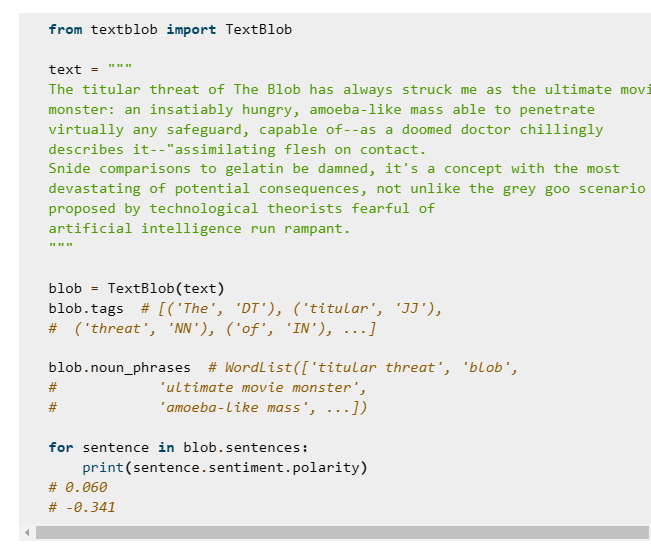
TextBlob is a Python library designed for handling textual data, providing an intuitive API to carry out various natural language processing functions such as part-of-speech tagging, sentiment analysis, noun phrase extraction, and classification tasks. Built on the foundations of NLTK and Pattern, it integrates seamlessly with both libraries. Notable features encompass tokenization (the division of text into words and sentences), frequency analysis of words and phrases, parsing capabilities, n-grams, and word inflection (both pluralization and singularization), alongside lemmatization, spelling correction, and integration with WordNet. TextBlob is compatible with Python versions 2.7 and higher, as well as 3.5 and above. The library is actively maintained on GitHub and is released under the MIT License. For users seeking guidance, thorough documentation is readily accessible, including a quick start guide and a variety of tutorials to facilitate the implementation of different NLP tasks. This rich resource equips developers with the tools necessary to enhance their text processing capabilities.
API Access
Has API
Yes
API Access
Has API
Yes

Integrations
Python
Yes
C
Yes
Cython
Yes
NLTK
No
NumPy
Yes
fastText
Yes
word2vec
Yes
Integrations
Python
Yes
C
No
Cython
No
NLTK
Yes
NumPy
No
fastText
No
word2vec
No
Pricing Details
Free
Free Trial
No
Free Version
Yes
Pricing Details
No price information available.
Free Trial
No
Free Version
No
Deployment
Web-Based
No
On-Premises
No
iPhone App
No
iPad App
No
Android App
No
Windows
Yes
Mac
Yes
Linux
Yes
Chromebook
No
Deployment
Web-Based
No
On-Premises
No
iPhone App
No
iPad App
No
Android App
No
Windows
Yes
Mac
Yes
Linux
Yes
Chromebook
No
Customer Support
Business Hours
No
Live Rep (24/7)
No
Online Support
Yes
Customer Support
Business Hours
No
Live Rep (24/7)
No
Online Support
Yes
Types of Training
Training Docs
Yes
Webinars
No
Live Training (Online)
No
In Person
No
Types of Training
Training Docs
Yes
Webinars
No
Live Training (Online)
No
In Person
No
Vendor Details
Company Name
Radim Řehůřek
Founded
2009
Country
Czech Republic
Website
radimrehurek.com/gensim/
Vendor Details
Company Name
TextBlob
Country
United States
Website
textblob.readthedocs.io/en/dev/
Product Features
Natural Language Processing
Co-Reference Resolution
No
In-Database Text Analytics
No
Named Entity Recognition
No
Natural Language Generation (NLG)
No
Open Source Integrations
No
Parsing
No
Part-of-Speech Tagging
No
Sentence Segmentation
No
Stemming/Lemmatization
No
Tokenization
No
Product Features
Natural Language Processing
Co-Reference Resolution
No
In-Database Text Analytics
No
Named Entity Recognition
No
Natural Language Generation (NLG)
No
Open Source Integrations
No
Parsing
No
Part-of-Speech Tagging
No
Sentence Segmentation
No
Stemming/Lemmatization
No
Tokenization
No
